
Lorton Previous Residents by Era
A Lorton address has a layered paper trail. The current Fairfax County parcel record establishes the place now, while the recorded deed trail explains ownership changes. Older work often shifts to index books, original deed volumes, tax books, maps, and library collections. Those sources do not all identify the same people. A deed establishes a transfer party; a directory or census can help show a household associated with an address at a particular time.
| Source | Years It Covers | Where Held | What It Shows |
|---|---|---|---|
| iCare parcel profile | Current assessment record | Fairfax DTA iCare | Owner, situs and mailing fields, PIN, legal description, sales, values, and a printable summary |
| Fairfax land records | 1742-present | Circuit Court, CPAN, and public terminal | Recorded deeds and their parties, placement, and legal land language |
| CPAN land index data | 1980-present, book 5391 onward | CPAN subscription service | Modern searchable index data and document access where entitled |
| Index-book images | 1742-1979, A1-5390 | CPAN and court research channels | Earlier grantor and grantee index paths |
| Historic Records Center | Original deeds 1742-1942; grantor/grantee books 1866-1946 | HRC, Fairfax | Original volumes and the direct bridge to earlier party searches |
| HRC tax books | Land 1851-1980; personal property 1851-1939 | HRC | Historical land or tax context; early volumes can be incomplete or fragile |
| Directories and census | Directory run needs catalog confirmation; census releases generally reach 1950 in 2026 | Virginia Room, library resources, and census channels | Possible occupants and household snapshots, not continuous proof of residence |
Start with the time period that matters. Current questions begin with iCare and the purchase deed. An older transfer calls for the CPAN index split or HRC, while occupant questions need a catalog check at the Virginia Room and the closest released census. PLUS can add public permit or planning clues, and its legacy fallback is LDIH when a historical record does not appear. No Lorton-specific Sanborn volume was verified, so a fire-insurance map should not be assumed.
Lorton Parcel Snapshot First
Open the Fairfax iCare address search before chasing a surname. Its Number, Unit#, Street, and Suffix fields can identify the current parcel. Save the owner field if visible, parcel or tax-map number, legal description, current situs, mailing address, sale links, and value date. Use the printable summary as a research log rather than relying on memory after several transfers.
iCare separates a property's situs from the address used for tax mail. The mailing field may point elsewhere, and it does not show that someone lives at the parcel. Ownership, characteristics, sales dates, and prices update twice weekly; assessed values are dated January 1. A web owner field may also be withheld at the owner's request. That is not proof that the county lacks the record, because the DTA office or phone route can remain available under applicable law.
Lorton Deeds Before 1980
For Lorton previous residents, 1980 is an index transition, not the beginning of Fairfax land records. Fairfax Circuit Court Land Records research describes land material from 1742 forward. CPAN's searchable land-index data begins at book 5391 in 1980, while the earlier 1742-1979 index-book images use A1 through 5390. The Historic Records Center preserves original deed books from 1742 through 1942 and grantor/grantee index books from 1866 through 1946.
Choose the access channel by era and need. CPAN is a subscription service; the court research room has public terminals; HRC research is an appointment-requested office route. For a copy, first identify the instrument number or book and page. A certified copy costs $2 per document plus $0.50 per page. A mailed request needs the instrument or book/page, payment, and a self-addressed stamped envelope; the court says ordinary mail processing is generally within two weeks. Do not send cash or cards by mail.
The land-record copy instructions also give the in-person and mail process. This range of channels matters when an online name search ends at the data split or a document needs a certified copy.
Lorton Addresses Become Tracts
Older Lorton records can describe a tract, road, subdivision, lot, block, creek, or neighboring owner instead of a current street number. Test a failed address search with the subdivision, lot, legal description, adjacent owners, spelling variants, and estate, trust, or corporate party names. The Fairfax chain often works because the legal description stays closer to the land than a street number does.
The Fairfax Digital Map Viewer provides a useful comparison layer for changing parcels and property maps. It cannot prove a boundary or occupant identity, but it can help connect an older tract label to an address investigation. MAR historical status and Jade imagery are further checks before making a connection.
See the official historical property-map series before carrying an old label forward.
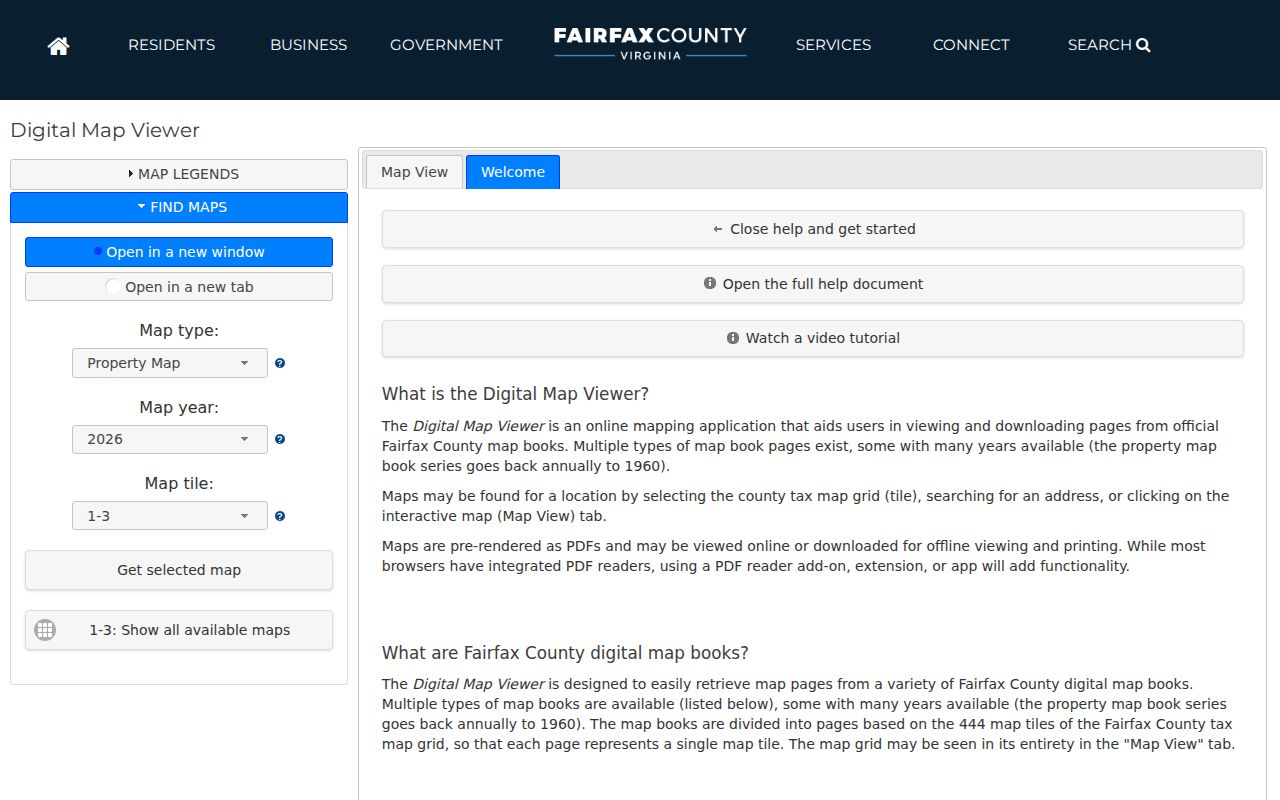
These map layers help document a geographic hypothesis, but the recorded plat or deed remains the legal source for the land description.
Trace Lorton Previous Residents Deeds
The reliable backward method is current parcel, current purchase deed, then seller as earlier buyer. After iCare supplies the present owner and legal description, obtain the current purchase deed through CPAN, a public terminal, or a copy request. Capture its recording date, instrument or book/page, grantor, grantee, consideration when shown, legal description, subdivision or lot, and related conveyances. Then look for that grantor in the earlier records as a grantee.
- Freeze the iCare parcel snapshot and note its legal description and PIN.
- Find the latest recorded purchase instrument and record its parties and placement.
- Search the seller, now the grantor, as a prior grantee to locate the preceding acquisition.
- Repeat through name variants, marital names, trusts, estates, and entities while preserving the deed chain.
- Move into index-book images and HRC originals when the modern CPAN data ends.
- Grantor / grantee
- The grantor transfers an interest. The grantee receives it. Their roles reverse as the search moves backward through purchases.
- Chain of title
- The sequence of recorded transfers used to trace how an interest in a parcel passed from one party to another.
- Legal description
- The recorded parcel language, such as lot, block, subdivision, metes and bounds, or tract, used when a street address is missing or changed.
Use the Land Records Research instructions to keep the field notes consistent. Capture the party role and document reference, not just a name found in passing.
Review the Fairfax grantor/grantee research route before opening a record image.
The index is a route into the deed trail. A match still needs the instrument, legal description, and dates checked against the parcel.
Lorton Previous Household Evidence
Ownership is only one part of who lived here before. The Virginia Room's local-history guide points to city directories, telephone books, property history, newspapers, yearbooks, oral histories, and genealogy resources. The inspected official pages did not publish an exact year-by-year Lorton or Fairfax directory run, publisher list, or a verified digitized Lorton reverse directory. Ask staff for a catalog and shelf check instead of filling that gap with an assumed run.
Pair the oldest available directory before and after the date in question with the closest released federal census. In 2026, the general federal release period reaches 1950. A directory can be compiled before its print year, and a census represents another date, so retain that timing uncertainty. Compare street number, adjacent numbers, spelling, spouse or household notation, and other independent fields. The collections themselves are detailed in the Lorton city directories.
- Record the address spelling and legal description from the deed or parcel profile.
- Request the nearest directory years from the Virginia Room catalog and compare the same number with nearby numbers.
- Pair those findings with the nearest released census, noting its enumeration date.
- Use obituary, cemetery, probate, newspaper, yearbook, or permit clues when the directory trail stops.
Lorton Tax Books and Atlas
HRC tax books can place land in a historical owner and assessment context when the street number vanishes. Land and real-estate books run from 1851 to 1980, and personal-property books from 1851 to 1939. The earlier tax-book range is incomplete and fragile, and HRC may limit retrieval to three volumes at a time. That limitation is useful evidence, not a reason to fill a missing year with a guess.
Fairfax received a $21,450.60 HRC preservation grant in 2025 for the 1879 Atlas of Fairfax County and land tax books from 1892, 1900, and 1910. The grant preserves a strong bridge from older tract research toward later parcel mapping. The HRC preservation announcement identifies the materials and the county recordation-fee support.
Lorton Past Place Names
A Lorton previous residents search sometimes needs names that do not look like a neighborhood. Laurel Hill began as an eighteenth-century estate. The D.C. Workhouse and Reformatory opened in 1910 and was also called Lorton Prison, Lorton Reformatory, and Occoquan Workhouse. The last prisoners left in November 2001, and Fairfax received title in July 2002. A record under one of those names may describe the same historic setting without naming a current address.
Search Laurel Hill, Lorton Reformatory, D.C. Workhouse, Occoquan, historic district, road, tract, and the exact spelling found in the index. Fairfax's rural and institutional past also explains why a nineteenth-century record may use a landowner or tract rather than a familiar Lorton street. Note the term used by the source, then connect it only when the legal description, map, or recorded party supports the link.
Lorton Past Residents Carefully Closed
Obituaries, cemetery publications, and Fairfax probate records can close a historical trail. An obituary may identify a death date, relative, cemetery, or former address. A probate file may identify an executor or heir. Use those as leads, then return to the deed record to confirm an estate transfer. Keep a deceased person's historical facts separate from contact details for living people.
For records that are not online, the Virginia Freedom of Information Act (VFOIA) is Va. Code §2.2-3700 et seq., especially §2.2-3704. A specific request can seek non-exempt county records, but the law includes exemptions and does not open protected or sealed material. Ask the record custodian for the right offline channel when a public index is incomplete.
Lawful use. Lorton house-history research is for family history, estate matters, and personal curiosity. Do not use a record trail to locate, watch, harass, or harm a living person.